Bedding · Crib sleep surfaces
Choosing an Organic Crib Sleep Surface: Materials, Fit, and Care
A crib mattress is a small landscape with a consequential job: it must provide a firm, level place for a baby to sleep, fit the crib without dangerous gaps, and remain in good condition through daily use. Organic materials may matter to families, but a label alone cannot establish that a sleep surface is safe or suitable. Dimensions, construction, applicable safety requirements, and practical care all deserve a close look.
Begin with the sleep space, not the label
In a nursery, the crib may be surrounded by soft blankets, folded clothes, and carefully chosen bedding. The sleep surface itself should be approached differently. For an infant, the mattress needs to be firm, flat, and correctly fitted to the crib, with no added softness or loose items that could create a hazard. Organic cotton, wool, or other material descriptions are useful parts of a comparison, but they do not replace these basic checks.
Start by identifying the exact crib model and the mattress dimensions it is designed to accommodate. Then read the mattress label and manufacturer instructions. The measurements should correspond to the crib’s specifications, and the mattress should sit level and snugly within the frame. A mismatch can leave a gap at a side or corner, or force the mattress into a position it was not designed to occupy.
Fit is not a minor detail that can be corrected by adding a pad or tightly tucking a sheet. If the mattress seems too small, too large, bowed, or difficult to position, stop and check the crib and mattress documentation. Do not use improvised fillers to close a gap. Contact the manufacturers for guidance or choose a compatible mattress rather than trying to adapt an unsuitable one.
How to evaluate crib mattress fit
Crib dimensions and mattress dimensions are related but not interchangeable terms. A crib’s stated size describes the space its frame is intended to hold; a mattress listing describes the product’s own measurements. Small differences in construction, corners, and frame design can affect how the two meet. Use the crib maker’s specifications and the mattress maker’s fit guidance rather than relying on a generic size name alone.
Once the mattress is installed as directed, inspect its edges around the full perimeter. It should lie flat, remain stable, and not ride up against the sides in a way that creates a ridge. The fit should be close enough that there are no hazardous openings between the mattress and crib. Follow the crib’s manual for any manufacturer-provided fit check; do not substitute an informal test for the product instructions or applicable safety guidance.
- Confirm compatibility: Match the mattress to the specific crib model or to its stated dimensions and requirements.
- Check every edge: Look at both long sides, both ends, and the corners after the mattress is placed correctly.
- Look for a level surface: The mattress should not be warped, sagging, or forced into the frame.
- Recheck after adjustments: When the crib mattress support is moved to another height, confirm that the mattress remains correctly seated.
- Use only a fitted sheet designed for the mattress: Avoid adding toppers, cushions, positioners, or other products unless the crib and mattress instructions and current safe-sleep guidance specifically permit them.
A snug fit is essential, but it is one part of a wider safe-sleep setup. Follow current advice from your pediatric care team and relevant public-health authorities. A mattress’s materials, price, or certification should never be treated as a substitute for an appropriate sleep environment.
Read the material list layer by layer
“Organic crib mattress” can sound like a single, precise description. In practice, it may refer to one component, several components, or a particular stage of production. The cover could be cotton while the core is made from another material. A product may use wool in a quilted layer, or latex in a support layer, with different sourcing and processing claims for each. A clear product description should identify what is present and where it appears in the mattress.
Cotton: cover, fabric, and filling
Cotton may be used in a ticking—the outer fabric covering the mattress—or in an internal layer. These roles are distinct. A cover made with organic cotton does not automatically mean every layer is organic, and a statement about cotton farming does not by itself describe the complete mattress. Look for the named component, its proportion where provided, and documentation that explains the claim.
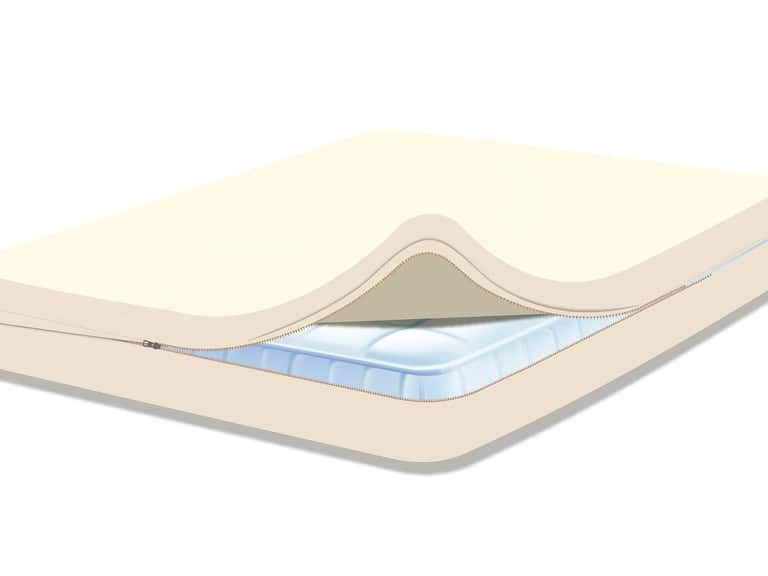
Fabric construction also affects everyday use. A tightly woven cover, a quilted surface, and a removable cover each have different cleaning and wear implications. For a crib mattress, the maker’s instructions should make clear how to respond to spills and whether a cover can be removed. Do not assume that a natural-fiber cover is machine washable or that washing will preserve the mattress’s fit and structure.
Wool: a distinct component with specific care needs
Some mattresses use wool in upholstery or as part of their fire-barrier construction. The exact purpose and location should be described by the manufacturer. Wool’s presence does not tell a family how firm the finished surface is, how it was processed, or how to clean the product. Ask for clear information about the wool layer, any relevant certification, and what care is permitted.
Wool can be sensitive to heat, agitation, and moisture, depending on the construction. A mattress that contains wool may therefore have care restrictions that differ from those of a removable cotton sheet. If the product is marked spot-clean only, soaking or machine-washing it could damage internal layers or affect its shape. Follow the mattress instructions rather than applying general laundry practices.
Latex and other core materials
Latex, foam, fiber, and spring-based components are not interchangeable simply because they appear within a mattress. They create different constructions and may carry different material and processing claims. When a listing uses terms such as “natural,” “organic,” or “low chemical,” identify which material the wording describes and which parts it does not cover.
Ask whether a statement refers to the raw material, the finished component, the cover, or the entire product. A concise layer diagram or written construction breakdown can make these distinctions easier to understand. If a label is broad and the supporting details are hard to locate, contact the manufacturer before relying on the claim.
What certifications can—and cannot—tell you
Certification marks can help make a complicated materials story more legible. Depending on the program, a certification may address organic fiber production, processing, chemical restrictions, emissions, or other defined criteria. These schemes do not all test the same things. A mark is most useful when the manufacturer identifies the certifying organization, the certified product or component, and the standard or scope involved.
Distinguish product-level claims from component-level claims. A certification for cotton fabric may not apply to the mattress core, and a certification related to emissions should not be read as proof of organic content. Similarly, an organic claim does not automatically answer whether a mattress has been tested to the safety requirements that apply to crib sleep products.
When evaluating documentation, look for details that can be checked rather than relying on reassuring adjectives. Useful information includes the certification name, the covered material, the scope of the claim, and current documentation or a way to verify it. If the paperwork is unclear, ask the company to explain exactly which layers are included.
Questions to ask about a label
- Which specific material or layer is certified?
- Does the certification apply to this exact product, or only to a component or facility?
- What does the standard assess, and what falls outside its scope?
- Can the manufacturer provide documentation or a verification reference?
- Are safety compliance and material certification being described separately?
Organic status is a sourcing and production question, not a complete safety verdict. A thoughtfully sourced mattress still needs to fit the crib, remain firm and level, and be used according to its instructions. Treat certifications as evidence about defined claims—not as a shortcut around product research.
Construction and the feel of a firm, flat surface
Inside a crib mattress, the core supports the surface while the cover and any upholstery layers complete the construction. The finished product should provide the firm, flat sleep surface specified for infant use. A plush top layer or added topper may feel comfortable to an adult’s hand, but softness is not a reason to modify a crib mattress. Follow the product directions and current safe-sleep recommendations.
Construction details can help explain how a mattress is assembled and maintained. Ask whether the cover is fixed or removable, whether the mattress is designed to be used on either side, and whether the manufacturer specifies an orientation or a particular support base. Do not flip or rotate a mattress unless its instructions allow it. Some products have distinct sides or a prescribed direction of use.
For families comparing several organic crib mattresses, create a simple record of the core, cover, internal layers, dimensions, weight, care method, and warranty. This turns a collection of marketing claims into a practical comparison. It also makes it easier to notice when one product provides clear, verifiable information and another leaves important questions unanswered.
Care that protects the surface and its shape
Care begins before the first night. Read the full instructions for the mattress and any protector or fitted sheet you plan to use. The permitted cleaning method may depend on the cover, waterproof layer, stitching, and internal filling. A mattress can look sturdy while still being vulnerable to excess water, high heat, or harsh cleaning products.
For routine care, use only the methods stated by the manufacturer. If spot cleaning is allowed, follow its directions for the cleaning agent, amount of moisture, and drying. Make sure the sleep surface is completely dry before use. Avoid soaking the mattress or applying bleach, disinfectants, essential oils, or other treatments unless the maker explicitly approves them; unapproved products can damage materials or leave residues.
A fitted protector may help limit everyday moisture and soil, but it must be compatible with the mattress and used as instructed. Choose a product that fits securely and does not alter the mattress’s flatness or firmness. A protector is not a replacement for a correctly fitted mattress, and multiple padded layers can change the surface in ways that are not appropriate for an infant sleep space.
- Keep the manufacturer’s care and warranty documents accessible.
- Use the specified fitted sheet and compatible protection only.
- Respond to spills promptly using approved cleaning instructions.
- Allow cleaned areas to dry fully before putting bedding back in place.
- Inspect seams, cover, and edges periodically for damage or changes in shape.
Cleaning routines should be practical as well as gentle. A washable sheet that can be changed easily may be more useful for daily hygiene than a complicated treatment applied directly to the mattress. For a protector, check whether it can be laundered, what temperatures are allowed, and whether drying instructions could cause shrinkage or loss of fit.
Know when a mattress needs closer attention
Repeated use, storage, moisture, and ordinary wear can change a mattress over time. Examine it for a sagging or uneven surface, torn fabric, broken seams, persistent dampness, or an odor that remains after approved cleaning. Check the crib frame and mattress support as well; damage or loose components in either part can affect how the sleep surface sits.
Follow the manufacturer’s guidance about lifespan, inspection, and replacement. A hand-me-down mattress deserves particular scrutiny because its history may be unknown: it might have been stored improperly, exposed to moisture, or used with a different crib. The product label and instructions should remain available, and the mattress should still meet the current crib’s fit requirements and applicable safety expectations.
A warranty describes the maker’s terms for certain defects; it is not proof that a used mattress remains appropriate for another crib or child. Likewise, a mattress that appears clean may have internal damage that is not visible. When condition or compatibility is uncertain, seek guidance from the manufacturer or a qualified child-safety resource rather than guessing.
A practical comparison checklist
Before choosing among organic crib sleep surfaces, compare the facts that affect fit, use, and care. A concise checklist can keep attention on details that are easy to overlook when a product description emphasizes natural materials or environmental claims.
- Identify the crib: Record its make, model, and mattress requirements.
- Verify dimensions: Check the product’s stated size and confirm compatibility with the crib.
- Review construction: Identify the core, cover, and every stated internal layer.
- Assess firmness and form: Confirm that the product is intended for the crib and provides the required firm, flat surface.
- Inspect claims: Separate organic content, emissions, and safety information; ask which component each claim covers.
- Understand care: Note whether cleaning is limited to spot treatment and whether a protector is recommended or restricted.
- Keep the paperwork: Save the label information, instructions, certification details, and warranty terms.
This process does not require choosing the most elaborate mattress or the one with the longest list of materials. It calls for a product with understandable construction, reliable fit information, clear care directions, and claims that can be substantiated. A simpler, well-documented description can be more useful than a sweeping promise.
Common questions about organic crib mattresses
Does “organic” mean a crib mattress is automatically safer?
No. “Organic” generally describes how particular materials are produced or processed under a defined standard. It does not, on its own, establish crib compatibility, firmness, fit, or compliance with every safety requirement. Assess the product as a whole and check the scope of each claim.
Can I use a topper to make a crib mattress softer?
Do not add a topper or other soft layer unless it is expressly permitted by the crib and mattress instructions and consistent with current safe-sleep guidance. A crib mattress should not be modified to change its firmness or contour.
Are cotton and wool mattresses easier to clean?
Not necessarily. Natural fibers have different cleaning limits, and the complete construction—not just the fiber name—determines the appropriate method. Check the exact product instructions before washing, spot treating, or using a protector.
What if the mattress fits one crib but not another?
Do not assume that a mattress will fit every crib described by the same general size. Compare the dimensions and requirements for the exact crib model, then confirm the installed fit. If the mattress is loose, warped, or difficult to seat, ask the manufacturers for direction.
A thoughtful choice is built on specifics
Choosing an organic crib sleep surface is not a contest in attractive labels. It is a sequence of practical decisions: match the mattress to the crib, examine the entire construction, verify what certifications actually cover, and follow care instructions that preserve the product’s form. Materials matter, but they are one part of a larger picture.
When descriptions are precise and fit is confirmed, families can make a more informed choice without confusing a sourcing claim with a safety guarantee. Keep the crib instructions close, inspect the sleep surface regularly, and rely on current guidance from trusted child-health and safety authorities for the sleep environment around it.